

Your shopping cart is empty!
×
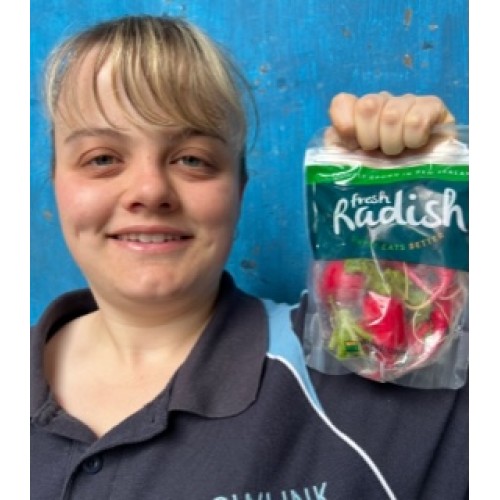
-500x500.jpg "RED RADISHES GROWN IN HOROWHENUA BAG OF 200Grams")

Price:
$4.50
Ex Tax: $3.91
Qty:

Avoid peeling radishes as many nutrients & phytonutrients are more concentrated in the peel.
Just wash the root thoroughly, trim the tip ends & if you have to peel, then gently pare away a superficial thin layer only
They are sweet & juicy but also have a hot, peppery flavour
Radishes are good for diabetics as it helps stabilize blood glucose levels & promotes slow release energy
Radish improves digestion as it can provide relief from common digestion orders
Radishes add instant zing to any dish, whether sliced raw as a garnish or added to salads
Can be sauteed, steamed, grilled, roasted
Radishes have low quanities of saturated fat & cholesterol which is due to the high water content in radishes (around 90%)...in addition to this they contain a wide range of essential vitamins & minerals
Radishes have both antifungal & antibacterial properties
The word radish is derived from the Latin words ‘radix’ meaning root, & ‘raphanus’ meaning easily grown.
However radish is really a swollen stem rather than a root even though it grows underground.
However radish is really a swollen stem rather than a root even though it grows underground.
Eat red radishes raw as a snack, in salads & in sandwiches or use as a garnish.
Remove tops & refridgerate in a plastic bag. Use promptly.
| Nutrition Information | ||||
| Serving size: 1 radish - 15g | ||||
|
Average Quantity per serving |
% Daily intake per serve |
Average Quantity per 100g |
||
| Energy (kJ/Cal) | 13/3 | 0.1% | 87/21 | |
| Protein (g) | 0.1 | 0.2% | 0.9 | |
| Fat, total (g) | 0.08 | 0.1% | 0.5 | |
| - saturated (g) | 0.02 | 0% | 0.1 | |
| Carbohydrate (g) | 0.4 | 0.1% | 2.6 | |
| - sugars (g) | 0.4 | 0.4% | 2.6 | |
| Dietary fibre (g) | 0.2 | 0.7% | 1.1 | |
| Sodium (mg) | 8 | 0.3% | 56 | |
| Vitamin C (mg) | 3.6 | 9% RDI* | 24 | |
| Iron (mg) | 0.3 | 2% RDI* | 1.8 | |
| Folate (µg) | 3.5 | 2% RDI* | 23 | |
| Potassium (mg) | 35 | 230 | ||
| Vitamin B6 (mg) | 0.02 | 0% RDI* | 0.1 | |
|
Percentage Daily Intakes are based on an average adult diet of 8700 kJ |
||||
|
Source: The Concise New Zealand Food Composition Tables, 10th Edition, Plant & Food Research - 2014 |
||||